
- All
- Product Name
- Product Keyword
- Product Model
- Product Summary
- Product Description
- Multi Field Search

Views: 0 Author: Site Editor Publish Time: 2026-07-20 Origin: Site


Bathroom moisture management presents a persistent challenge for households and facility managers alike. The cycle of damp floors, lingering humidity, and the rapid development of mildew on textiles creates an environment that compromises both hygiene and safety. Standard bath mats frequently fail to evaporate moisture fast enough between uses. This constant dampness leads to bacterial growth, unpleasant odors, and the need for constant laundering, which ultimately degrades the material over time. Evaluating floor covering options requires a technical comparison of moisture dynamics, maintenance realities, safety profiles, and long-term hygiene. We need to determine whether the rapid-drying properties of a diatom mud bath mat justify the shift away from standard fabric options. This analysis explores how these materials handle daily water exposure and what that means for your bathroom environment.
Selecting the right bathroom mat goes beyond matching paint colors. It requires evaluating how materials perform under constant moisture stress. We must look at specific functional criteria to understand how different mats impact bathroom safety and cleanliness. When you step out of a shower, the floor covering must immediately manage the water transferring from your body to the floor. If it fails, water pools, creating a slip hazard and a breeding ground for bacteria.
The primary job of any bath mat is handling water. We evaluate how quickly a material draws water away from the surface. Capillary action determines this speed. We also measure the subsequent evaporation rate in standard indoor humidity. Fast evaporation prevents standing water and reduces slip hazards. In a typical residential bathroom with average ventilation, a mat that stays wet for more than two hours is failing its primary moisture management objective.
Bathrooms provide ideal conditions for mold spores, mildew, and odor-causing bacteria. A mat's susceptibility to harboring these organisms under daily moisture loads dictates its hygienic lifespan. Materials that stay wet longer naturally breed more bacteria. Organic fibers like cotton act as a food source for these microbes when combined with dead skin cells and sustained moisture.
Safety relies on the coefficient of friction between the mat and wet feet. We must also consider the mat's grip on various bathroom floor substrates like tile, vinyl, or stone. A mat that slides across wet tile creates a severe hazard. Rubber backings on fabric mats often degrade, losing their grip over time, while rigid mats require specific underlayments to remain stationary.
Materials must conform to bathroom layouts. Sometimes, standard sizes do not fit. In these cases, the viability of sourcing a custom bathroom mat for non-standard vanity or shower dimensions becomes important. The mat should integrate seamlessly without creating tripping edges or blocking door swings.
We consider the ecological footprint of production. Synthetic fibers shed microplastics during laundering, impacting water systems. We also evaluate the ultimate end-of-life disposal options for these products once they degrade beyond use. Natural materials often have a more favorable end-of-life profile compared to synthetic foams and rubbers.
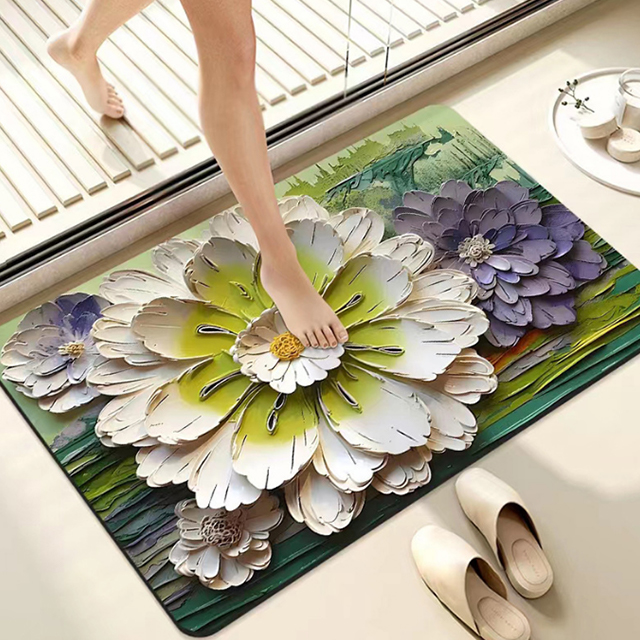
Fabric rugs have dominated bathroom floors for decades. They offer familiar comfort, but their material composition dictates distinct performance limitations when exposed to daily moisture. Understanding these limitations helps in making an informed decision about floor coverings.
The primary appeal of fabric is maintenance familiarity. The logistical ease of throwing a washable bathroom mat into standard household laundry systems allows for thermal and chemical sanitization. You can bleach white cotton mats to kill bacteria effectively, resetting their hygiene level weekly.
Despite easy washing, moisture retention remains inevitable in high-traffic bathrooms. This constant dampness leads to accelerated wear from frequent washing. Furthermore, the rubber backings on most traditional rugs degrade quickly in hot dryers, creating potential slip hazards as the grip fails. Once the backing flakes off, the mat must be discarded.
Diatomaceous earth introduces a completely different mechanism for moisture control. Instead of soaking up water like a sponge, it uses microscopic structures to trap and release moisture rapidly. This represents a shift from absorption to active moisture dissipation.
Diatomaceous earth consists of fossilized phytoplankton. This natural composition features incredibly high porosity. The microscopic pores create rapid capillary action that traps water instantly. Once trapped, the high surface area allows the water to evaporate back into the air quickly, utilizing ambient room temperature and airflow.
The performance metrics of DE are highly measurable. A high-quality diatom mud mat can absorb up to 150% of its weight in water. More importantly, surface-level moisture typically disappears in 10 to 15 seconds. This leaves the surface dry to the touch almost immediately after stepping off, preventing the next user from stepping onto a damp surface.
The lack of organic textile fibers prevents the colonization of bacteria and fungi. Mold requires sustained moisture and organic food sources to thrive. By eliminating both, DE mats effectively eliminate the sour bathroom mat odors common with fabric alternatives. They maintain a baseline level of hygiene without requiring weekly chemical intervention.
Comparing these two options requires looking at daily use, comfort, and design flexibility. Each material type serves different user priorities and bathroom environments.
| Performance Metric | traditional bathroom rug | Diatom Mud Bath Mat |
|---|---|---|
| Moisture Evaporation Rate | Slow (2-6 Hours) | Fast (1-5 Minutes) |
| Maintenance Protocol | Machine washing and drying | Surface wiping and light sanding |
| Underfoot Tactile Feel | Plush, warm, yielding | Firm, cool, rigid (hard version) |
| Inherent Mold Resistance | Low (requires active washing) | High (material is inorganic) |
| Floor Surface Requirements | Adapts to any surface | Requires flat, even flooring |
Traditional rugs require a high frequency of washing. Rubber backings often peel or flake after 12 to 18 months of heat exposure in dryers. Diatom mud mats demand low daily maintenance. They require occasional sanding (for hard mats) or wiping to remove surface oils and dust that clog pores. Their lifespan can exceed several years if not dropped or cracked.
Traditional rugs offer superior thermal insulation. They provide warmth and cushioning on cold mornings. Diatom mud mats present a firm, unyielding surface. The hard versions can feel distinctly cold in winter climates, which may deter some users who prioritize morning comfort over technical performance.
Fabric rugs offer infinite colors and textures. You can easily find specific shapes for architectural cutouts. Diatom mud mats are limited primarily to standard rectangular or oval dimensions. Because they rely on raw natural materials, their colors are typically muted, earthy tones, though manufacturing advancements are slowly expanding the color palette.
No flooring solution is perfect. Adopting diatomaceous earth mats introduces specific physical and maintenance risks that differ entirely from fabric care. You must understand these operational realities before making a switch.
Hard diatom mats can trap grit underneath them. If a protective anti-slip mesh is not used, this grit can scratch luxury vinyl plank (LVP) or polished stone floors. Always use the provided rubber underlayment to create a protective barrier between the rigid board and the finished floor.
Hard diatom mud mats lack flexibility. They can crack or shatter if placed on uneven tiles. Dropping them during cleaning will also cause them to break. They require careful handling compared to indestructible fabric rugs. You cannot simply kick them out of the way.
Soaps, lotions, and natural body oils will eventually seal the microscopic pores of a diatom mat. When this happens, water pools on the surface instead of absorbing. Restoring functionality requires mechanical abrasion, usually lightly sanding the surface. Many buyers do not anticipate this specific maintenance step and mistakenly assume the mat is defective.
Sanding DE mats creates fine dust. There is a risk of inhaling crystalline silica during the restoration process. You must wear a mask during maintenance. Alternatively, perform wet sanding to keep dust particles bound to water and out of the air, ensuring a safe maintenance procedure.
A: A typical diatom mud mat lasts between 1 to 3 years. This lifespan depends heavily on proper maintenance, such as periodic sanding, and avoiding physical impacts that cause the rigid board to crack or shatter.
A: Hard diatom mats cannot be machine washed; they will break and damage the machine. Some soft, flexible composite diatom mats can be rinsed or wiped down, but they rarely survive the agitation of a washing machine.
A: Over time, skin oils, dust, and soap residue accumulate and clog the microscopic pores of the material. The solution is to lightly sand the top surface with high-grit sandpaper to expose a fresh, absorbent layer.
A: Yes, but you must use the included rubber mesh underlayment. Placing a hard, rigid board directly on luxury vinyl plank can trap grit underneath, which may scratch or gouge the flooring when the mat shifts.
A: No. The material is inorganic, providing no food source for microbes. Furthermore, its rapid-drying capability removes the sustained moisture required for mold and bacterial colonization to occur.


