
- All
- Product Name
- Product Keyword
- Product Model
- Product Summary
- Product Description
- Multi Field Search

Views: 0 Author: Site Editor Publish Time: 2026-08-18 Origin: Site


Commercial flooring decisions carry significant operational weight. The wrong specification leads to premature wear, acoustic issues, and costly facility downtime. Facility managers and procurement teams must balance upfront material durability, daily maintenance requirements, and the physical constraints of occupied commercial spaces. You need flooring that withstands heavy foot traffic while supporting workplace productivity without requiring constant, disruptive maintenance. This guide provides a technical evaluation framework for selecting modular textiles. We compare material specifications, backing technologies, design flexibility, and installation realities. You will learn how to navigate subfloor preparation, evaluate face fibers, and mitigate installation risks to ensure a high-performing commercial environment. By understanding the mechanics of yarn construction and dimensional stability, you can specify materials that genuinely perform in the field.
Targeted Replacement: Modular carpet flooring drastically reduces lifecycle costs by allowing isolated replacement of high-traffic or damaged areas without clearing entire rooms.
Material Dictates Lifespan: Nylon remains the industry standard for commercial durability, while loop pile construction prevents the crushing commonly seen in high-traffic zones.
Backing Matters as Much as Fiber: Specifying PVC backing carpet tiles ensures dimensional stability, preventing the curling and shifting that cause trip hazards.
Design and Zoning: Beyond utility, office carpet tiles offer unmatched flexibility for wayfinding and defining distinct work zones in open-plan environments without the need for physical walls.
Installing traditional broadloom carpet in an occupied commercial space presents severe logistical hurdles. You must clear entire floor plates, dismantle workstations, and disconnect complex data cabling. This process often forces businesses to shut down operations for days. Broadloom requires stretching and permanent adhesive bonding, making phased installation nearly impossible without creating visible, weak seams that fray under heavy foot traffic.
Conversely, modular carpet flooring enables phased, localized installation. Installers frequently use specialized furniture-lifting jack systems to elevate workstations just enough to slide old flooring out and new tiles in. This allows facility teams to replace flooring overnight or during weekends. Employees return to a new floor on Monday morning without ever packing up their desks. The operational continuity provided by this modular approach heavily outweighs traditional roll carpet methods, keeping facility downtime to an absolute minimum.
Commercial floors wear unevenly. Corridors, elevator lobbies, and the areas directly under rolling office chairs experience extreme abrasion. Broadloom forces you to live with these worn patches or undertake a massive replacement project. You cannot easily patch a roll of carpet without the repair looking obvious and unprofessional, as the new piece will never perfectly match the stretched, worn surrounding area.
Replacing individual 50x50cm or 24x24in tiles solves this problem. Facility teams can swap out damaged or heavily soiled squares in minutes. If a coffee spill ruins a section in the breakroom, maintenance staff simply pull up the affected squares. They can deep-clean these tiles off-site or replace them entirely. To ensure seamless replacements, you must secure attic stock. Ordering an extra 5 to 10 percent of material during the initial purchase guarantees you have identical tiles from the same dye lot. Mixing dye lots from later production runs often results in a subtle but noticeable checkerboard effect.
Open-plan environments suffer from poor acoustics. Hard surfaces like luxury vinyl tile (LVT), polished concrete, and hardwood reflect sound waves. This creates an echo chamber that amplifies conversations, ringing phones, and foot traffic. High ambient noise levels directly reduce employee concentration and increase workplace fatigue, leading to lower overall productivity.
Modular tiles provide excellent acoustic mitigation. We measure this using the Noise Reduction Coefficient (NRC) and Impact Insulation Class (IIC). A higher NRC indicates better sound absorption. The layered structure of office carpet tiles traps ambient noise within the face fibers and backing materials. Furthermore, they drastically reduce impact sound transmission between floors. Footfalls become muffled, preventing heavy walkers from disrupting focused work zones. When acoustic control is a primary facility requirement, modular textiles outperform resilient hard flooring every time.
Modern commercial interiors rely heavily on open-plan layouts to maximize natural light and floor space. However, occupants still need distinct areas for collaboration, focused work, and relaxation. Building physical walls defeats the purpose of an open layout and triggers expensive HVAC and lighting modifications that complicate future office reconfigurations.
You can utilize contrasting colors, textures, and patterns of commercial carpet tiles to create visual boundaries. A sudden shift from a neutral grey workstation area to a vibrant, textured pattern instantly signals a transition into a collaborative breakout zone. This psychological cue helps employees adapt their behavior to the space. Strategic flooring design boosts employee morale and reinforces brand identity. You can integrate corporate colors into reception areas or use biophilic designs featuring organic patterns to reduce workplace stress.
Navigating large corporate campuses or healthcare facilities often confuses visitors. Instead of relying solely on wall-mounted signage, architects use flooring as an intuitive wayfinding tool. Distinct tile designs subtly guide foot traffic along main arteries and corridors, providing clear visual cues without cluttering the walls.
By installing a contrasting linear pattern down a main hallway, you naturally draw people along that path. This strategy keeps heavy footfall away from sensitive, quiet work zones. You can also use directional patterns to indicate exits, highlight elevator banks, or mark safe walking zones in mixed-use industrial facilities. The modular nature of the product allows you to update these pathways easily if the office layout changes in the future.
When specifying commercial flooring, the face fiber dictates the lifespan of the installation. Nylon dominates the commercial sector due to its exceptional durability and resilience. The industry primarily uses two variations: Type 6 and Type 6,6 Nylon. Type 6,6 features a tighter molecular structure, offering slightly better stain resistance and heat resistance. Type 6 is highly recyclable and still provides excellent commercial performance.
Nylon possesses superior memory. When subjected to heavy foot traffic or the constant rolling of office chairs, nylon fibers bounce back to their original shape. This crush resistance prevents the traffic lanes that quickly ruin cheaper carpets. For maximum longevity, specify solution-dyed nylon. In this process, the color pigment mixes into the liquid polymer before extrusion. The color goes all the way through the fiber, much like a carrot. This renders the carpet highly resistant to fading from UV light and harsh cleaning chemicals, including diluted bleach solutions.
Olefin offers excellent chemical resistance and is naturally hydrophobic. It repels water-based stains and resists fading under heavy sunlight. This makes it suitable for specific environments like entryways prone to wet shoes or spaces with massive exterior windows where UV exposure degrades other materials.
However, Olefin and Polyester share a severe limitation: poor crush resistance. These fibers lack the structural memory of nylon. Once they flatten under heavy traffic, they stay flat. This causes the flooring to ugly out long before it actually wears through the backing. You can specify these budget-friendly materials for low-to-medium traffic areas like private executive offices or secondary conference rooms. Using them in main office arteries or under rolling chairs presents a massive durability risk.
The way the yarn attaches to the backing impacts both aesthetics and performance. Low-profile loop pile remains the dominant choice for commercial environments. The yarn forms continuous loops, creating a dense, tight surface. This construction resists matting and allows office chair casters to roll easily without extreme ergonomic strain on the user.
Cut pile features loops that are sheared off, creating a softer, more luxurious texture. While visually appealing, cut pile shows footprints, vacuum marks, and traffic patterns immediately. Tip-sheared tiles offer a hybrid approach, mixing cut and loop yarns to create subtle textures. Reserve cut pile and tip-sheared options for executive boardrooms or low-traffic lounge areas where aesthetics outweigh extreme durability.
Fiber Material | Crush Resistance | Stain Resistance | Best Commercial Application |
|---|---|---|---|
Solution-Dyed Nylon (Type 6 / 6,6) | Excellent | Excellent (Colorfast) | High-traffic corridors, open offices, lobbies |
Olefin (Polypropylene) | Poor to Fair | Excellent (Hydrophobic) | Entryways, breakrooms, sunny areas |
Polyester | Poor | Good | Private offices, low-traffic lounges |
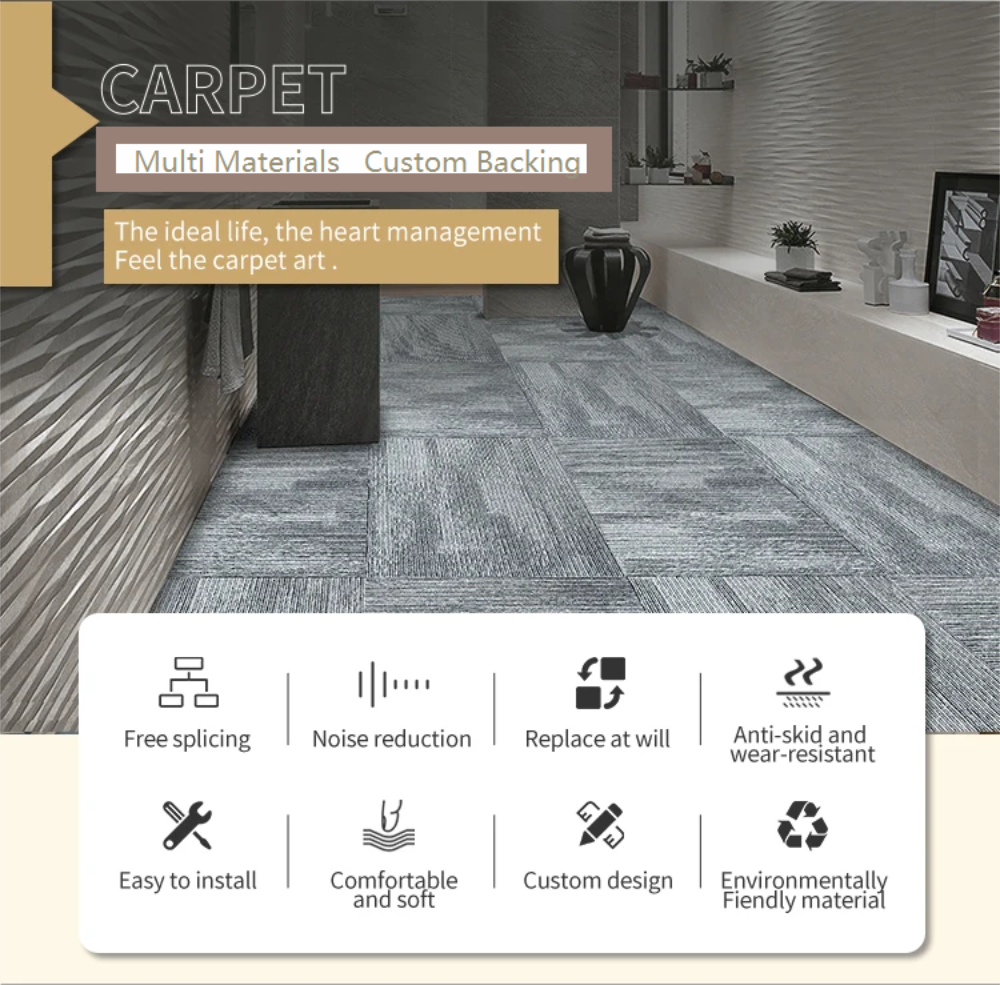
The backing system performs the heavy lifting in modular flooring. It must keep the tile perfectly flat under the stress of rolling loads and fluctuating indoor temperatures. PVC backing carpet tiles provide exceptional dimensional stability. The Polyvinyl Chloride layer, often reinforced with a fiberglass scrim, prevents the tile from expanding or shrinking regardless of environmental changes.
Without adequate dimensional stability, tiles suffer from edge curling or doming in the center. Curled edges create severe trip hazards and expose the seams to rapid fraying. PVC backing provides enough sheer weight to hold the tile firmly against the subfloor. This mass eliminates the need for full-spread permanent adhesives, allowing for easy removal and replacement without tearing the backing apart.
Standard hardback tiles offer durability but minimal underfoot comfort. For environments requiring prolonged standing, such as retail counters, pharmacies, or standing-desk zones, consider attached cushion backings. These backings usually consist of polyurethane foam or dense felt integrated directly into the tile structure.
Cushion backings significantly enhance acoustic absorption and reduce leg fatigue. However, they introduce a trade-off. Thicker cushions increase rolling resistance for office chairs. Employees may struggle to move smoothly across heavily cushioned floors, leading to ergonomic complaints. You must balance the need for ergonomic standing comfort against the practicalities of a seated, rolling workforce.
Concrete subfloors constantly emit moisture vapor. Installing non-breathable backings over high-moisture concrete slabs traps this vapor. The trapped moisture breaks down adhesives, causes the tiles to bubble, and creates a breeding ground for mold and mildew beneath the floor surface.
Before specifying a backing, you must understand the moisture conditions of the site. If the concrete exhibits high relative humidity (RH), you must specify moisture-mitigating backings or open-cell structures that allow vapor to pass through harmlessly. Alternatively, you will need to apply a topical moisture mitigation epoxy to the slab before installation, adding time and labor to the project.
Modular flooring follows the contours of the subfloor. If the concrete is wavy, cracked, or uneven, the tiles will telegraph those imperfections to the surface. Seams will peak, and corners will fail to align. You must ensure the subfloor meets strict levelness tolerances, typically no more than 3/16 inch variance over a 10-foot radius, as outlined by ASTM F710 standards.
Contractors must grind down high spots and fill low areas with Portland cement-based leveling compounds. Furthermore, you must conduct moisture vapor emission rate (MVER) and in-situ relative humidity (RH) testing via ASTM F2170. Skipping these tests to save time guarantees future adhesive failure. Hidden floor prep costs often derail budgets; assume the existing slab requires remediation until testing proves otherwise.
Commercial modular installations rarely use permanent glue. The industry standard relies on pressure-sensitive, releasable adhesives. Installers trowel or roll this adhesive onto the subfloor and allow it to dry to a tacky state. The tiles grip the tacky surface securely but peel up easily when replacement is necessary, leaving the subfloor intact.
Floating installation methods offer an alternative. Instead of applying adhesive to the subfloor, installers use proprietary adhesive tabs or stickers. These tabs connect the corners of the tiles to each other, creating a unified, floating textile floor. This method protects the subfloor from adhesive residue, speeds up installation, and drastically reduces the time required for future removal.
Installation direction drastically alters the final appearance of the floor. Manufacturers design tiles for specific installation methods to maximize aesthetic appeal and hide seams. You must instruct your installation team on the exact pattern required.
Monolithic: All tiles face the same direction, mimicking broadloom. This requires precise seam cutting to look correct and demands perfectly flat subfloors.
Quarter-Turn (Checkerboard): Each tile rotates 90 degrees from the adjacent one. This effectively masks seams and hides slight dye lot variations.
Ashlar: Tiles install in a staggered brick pattern, either vertically or horizontally. This breaks up linear traffic wear patterns and creates a modern aesthetic.
Strict inventory control during large-scale installations prevents aesthetic disasters. Installers must check box labels to ensure they only mix tiles from the same dye lot within a single continuous visual area. Mixing dye lots across a monolithic installation creates distinct, unacceptable color banding.
Modern commercial construction demands environmentally responsible materials. Modular flooring contributes significantly to LEED certification and corporate Environmental, Social, and Governance (ESG) goals. Because you only replace damaged tiles rather than entire rooms, the modular format inherently reduces landfill waste over the building's lifespan.
When specifying materials, demand high recycled content in both the face yarn and the backing matrix. Look for products utilizing regenerated nylon derived from discarded fishing nets and industrial waste. Indoor air quality also matters. Ensure the product carries low-VOC (Volatile Organic Compound) emission certifications, such as CRI Green Label Plus, to protect occupant health immediately following installation. Finally, evaluate the manufacturer's end-of-life reclamation programs. The best suppliers take back old tiles to recycle them into new flooring, creating a closed-loop product lifecycle.
Procuring material from a reliable source prevents project delays and post-installation failures. A reputable commercial carpet supplier provides transparent technical specifications and robust warranties. Do not accept generic wear warranties. You need specific coverage against edge ravel, zippering, delamination, and backing integrity.
Evaluate their lead times carefully. Custom patterns or specific dye lots often require 8 to 12 weeks for manufacturing and shipping. Always request physical samples before finalizing a purchase order. Digital renderings cannot accurately depict how a specific texture will react to your office lighting or how much rolling resistance a particular pile height will create for your office chairs. Test the physical samples on-site to guarantee performance.
Audit your floor plans to identify heavy-traffic arteries, rolling chair zones, and areas requiring acoustic mitigation before selecting fiber types.
Schedule a professional in-situ relative humidity (RH) test on your concrete slab to determine exact moisture mitigation requirements.
Request physical samples of solution-dyed nylon tiles from your supplier to test chair-roll resistance under real office conditions.
Order an additional 5 to 10 percent of attic stock from the original dye lot to guarantee seamless future replacements.
A: High-quality nylon tiles typically last 10 to 15 years in heavy commercial environments. Lifespan depends heavily on face fiber material, traffic volume, and adherence to a strict preventative maintenance schedule, including daily vacuuming and periodic hot water extraction.
A: You can install them over hard, flat, and well-bonded existing surfaces like VCT or terrazzo. However, you must never install them over existing carpet or heavily cushioned floors, as this destroys dimensional stability and voids the manufacturer warranty.
A: Implement daily vacuuming using dual-motor upright vacuums with HEPA filters. For deep cleaning, use hot water extraction with low-residue detergents. Address spills immediately to prevent permanent staining.
A: PVC provides superior dimensional stability and sheer weight. This prevents the edges from curling or doming under heavy rolling loads, ensuring the floor remains flat and safe without requiring permanent, full-spread adhesive.
A: Yes. Modular textiles possess a much higher Noise Reduction Coefficient (NRC) and Impact Insulation Class (IIC) than hard surfaces. They absorb ambient noise and muffle footfalls, making them vastly superior for acoustic control in open-plan offices.
A: Solution-dyed fibers have color pigment integrated directly into the liquid polymer before extrusion, making the color permanent and highly fade-resistant. Piece-dyed fibers are manufactured as white yarn and dyed later, making them more susceptible to fading and chemical bleaching.


